Build the Soil

Filed under: The Garden Gate, Land & Nature Stewardship, Our local Community — September 28, 2008 @ 5:12 pm

soil.jpg Yesterday I gave another Organic Vegetable Gardening Class at the Community Garden. As we are beginning to transition the beds to the new growing season (cool season, in our year round growing rotation), the topic was “Soil Preparation.”

We began with a reminder of the adage:

Feed your soil. Your soil feeds your plants, and your plants feed you.

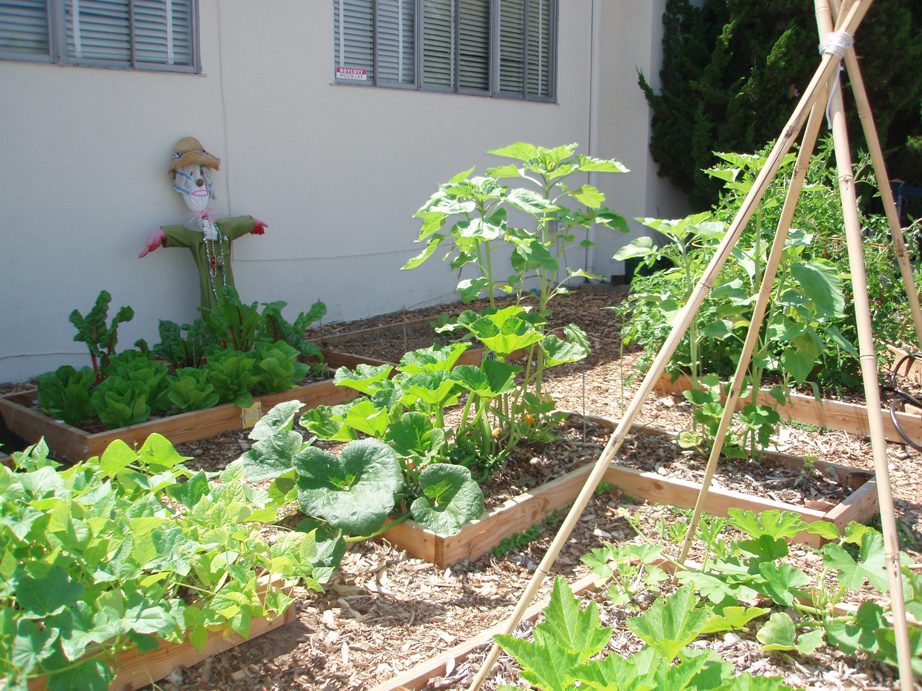
I used the story of the Community Garden as the backbone of the session. A year ago, our garden space was slightly sloped, dry, parched lawn and ancient (30+ y.o.) junipers. The sprinkler water (imported via pumps from as far away as the Owens River Valley, Northern California, and/or the Colorado River) rolled off the tightly compacted sandy textured soil, straight into the gutter, where it swept along street debris, washed into the storm drains, and flowed out into the Pacific Ocean. There was little organic matter in the soil to absorb and hold the water.

I reminded the attendees that for purposes of this talk, “organic matter” meant “small parts that used to be plants.” I brought plenty of samples, and we launched into a discussion of the difference between compost and mulch.

Mulch: For the most part, mulch particles are large in size, and not decomposed. Mulch goes on top of the soil. Think of it like a fluffy quilt that keeps the plants tucked in, and prevents evaporation.

Compost: Compost particles are fine in size. Ideally, they are decomposed, or at least partially decomposed. Compost gets mixed into the soil. It helps the soil retain water, plus it provides nutrients to our plants.

I showed samples of mulch and compost. One mulch sample was purchased bark chips from the local Armstrong’s nursery; another was “found materials” in the form of fallen citrus leaves swept up off my patio. The third example cited was the tree chippings used so liberally in the Community Garden.

Compost samples included a bag of purchased compost from the local Armstrong’s nursery, and finished homemade compost from my compost bin. We talked about how the only “compost” which was available for donation at the time we started the Community Garden wasn’t ideal — it wasn’t decomposed, and had some signs of undecomposed horse manure (when fresh, manure can burn the plants).

We examined the homemade compost, noting the earthworms, bugs. We talked about how these are only the visible part of the spectrum. Our soil is ALIVE. The children’s book Compost Critters by Bianca Lavies (available through LAPL) gives colorful pictures of the microscopic elements of our soil ecosystem: bacteria, mycorrhizal fungi, all sorts of microorganisms. These critters break down the organic matter in our soils and make its nutrients available to our plants. Our plants need the rich network of soil life in order to thrive.

When one gardens conventionally, pouring petrochemicals onto the soil, we kill off this rich network of soil life. We have to pour more and more chemicals onto this deadened soil in order to keep our plants going, because there’s nothing live going on in the soil to support our plant. Each application of sprays, chem fertilizers, weed killer, etc., perpetuates the dependency.

When we garden organically, these soil critters are our allies. The health of our plants depends upon them. Thus organic gardening is cultivating this rich series of symbiotic relationships.

Returning to the story of our Community Garden space, the first thing we did was to remove the grass and junipers. Many people ask me questions about grass removal, so I discussed the issue. I brought samples of grasses, weeded out of my garden that morning, including the insidious Bermuda Grass (Cynodon dactylon - images here , here and here).

Many people hear about methods such as the “Lasagne method” where you layer materials such as cardboard, black plastic, mulch, etc., onto grass and create a garden. I point out that Southern California must evaluate such recommendations carefully: Does the person who is telling of great Lasagne success live in a year-round growing season, or do they have the benefit of a frost to help eradicate weeds and pests? Does the storyteller have Bermuda grass?

Here in Southern California, without frost of any significance, and with nearly every backyard being populated with Bermuda grass, there is only one viable solution: dig, dig, dig some more, and then plan to dig again.

Methods like the Lasagne layering don’t work because Bermuda will lurk deep underneath all those layers, yellowed and bleached, but still very much alive. When given half a chance, it will tunnel up through holes in the barriers (it can create them) and take over your new patch.

We might tell ourselves we’ll use chemical methods like Roundup “just once,” and then return to organics. We’re kidding ourselves. Bermuda will lurk under the edges of the nearest concrete and come out again, demanding that we reapply chemicals again and again. And each time we reapply those chemicals, we must rebuild our decimated soil life all over again.

Some gardening manuals advocate “no till” methods. When we consider such things as the long, delicate, microscopic threads of the mycorrhizal fungus which reach webs throughout our soils, “no till” sounds like a really fine idea. But “no till” isn’t a viable option in an area with Bermuda and no hard frosts.

I described the double digging technique from John Jeavons’ How to Grow More Vegetables.

And I told how, at the Community Garden, we removed our Bermuda by digging and cutting it out, then raking to eliminate all that we could. Then we tilled our 1,250 sq ft garden area by using a rototiller. (Never use a rototiller prior to Bermuda grass removal - you will simply make your Bermuda problem worse by chopping it up. Each tiny bit will resprout!)

I described my personal experiences with Bermuda containment in a frost-free area:

  1. Be prepared to dig, and redig. Dig out every little tiny bit, every single white stolon (image1 , image2). In the months and years that follow, each time you see a Bermuda sprout, dig it out, including the white stolon.
  2. Use physical barriers. Choose the widest you can possibly find. For the Community Garden we used a product similar to “Master Mark Master Gardener Contractor Landscape Edging” (Ace Hardware). That will slow how fast the Bermuda invades, and will make it easier to cut it out.
  3. Grow great soil. The better my soil gets — the richer, the fluffier — the easier it is to pull out the long pieces of invading Bermuda.
  4. Shade helps. Biointensive spacing, as described by John Jeavons in How To Grow More Vegetables, is designed such that the foliage of one mature plant touches the foliage of its neighbor. Thus the soil is shaded. In shade, Bermuda grows spindly and is easier to remove.
  5. Mulch helps. When Bermuda has to grow up through mulch, it doesn’t cling to the soil very well and is easier to remove. Plus the soil texture beneath the mulch is vastly improved, making it much easier to pull the Bermuda.
  6. Spot irrigation helps. While your shrubs and trees are getting established, water only where you need to. That way, the Bermuda can’t thrive between the juvenile plants.

As we till, the soil becomes fluffier. We have introduced air pockets into our soil. Amazingly enough, our plant roots require some air. (Note: never walk on your freshly tilled soil. Designate pathways immediately and start to use them so that you don’t begin compacting all the air pockets, destroying your hard work!) In the example of our Community Garden, the soil beneath those ancient junipers was tightly compacted, sandy grain against sandy grain. There was not room for air or for water to absorb. The water rolled right off the top.

Grading is part of the answer. The topic of grading is too broad for this session — perhaps we’ll hold a grading session in the future. We used grading to terrace our slight slope and retain water on flat beds. Yes, we used a carpenter’s level to level our raised bed frames. If you look carefully at our site, the west (uphill) side of each bed frame is dug into the ground, while the east (downhill) side is at ground level, or even higher than ground level. In some beds, an additional piece was added to the frame on the downhill side. We chose to use raised beds at the Community Garden, not because we needed to raise the vegetables (actually, drought-wise it might have been better if we had not raised them) but because with so many people walking through the garden, we needed “crowd control.” We needed to clearly mark where the growing beds were versus the pathways so that people wouldn’t walk on our growing areas.

We talked about the simplest form of soil testing, checking the makeup of the soil particles. You take a scoop of soil, put it in a clear jar, and add water. Stir, then allow the sample to sit for several days. It will settle out into stripes. You then measure the stripes as a percentage of the whole. Locate your percentages on a diagram such as this triangle diagram. This will tell you whether your soil is sandy, clay, loam, or what combination of the three.

We discussed ways to add organic material. As we created the Community Garden, we knew it was devoid of organic material, thus we turned compost into the soil within each raised bed frame. In maintenance phase, we could conceivably top dress with compost, adding it to the surface of the soil rather than turning it in, because studies have shown that the nutrients will work their way down as we irrigate. This autumn, however, we will be turning in compost, rather than top dressing, because we are aware that our soil is still not as rich as we’d like it to be.

We turned to the topic of mulch. In our dry climate, we should mulch everything we can, whenever we can. I quoted Emilia Hazelip, saying nature abhors bare soil. Recall how in undisturbed natural areas, plants cover the soil with their leaf litter. Mulch keeps the moisture in the soil, and the rich network of soil critters needs moisture in order to survive.

How much mulch? Emilia Hazelip, gardening near the fields of France, used straw — about 10 inches of it! The Path to Freedom urban homestead project in Pasadena stated they use 4 to 6 inches of mulch. In other words, you need a lot!

However, when we’re planting tiny seeds, like lettuces, the seedlings can’t come up through big chunks of mulch. It just won’t work. Thus, if we’re direct seeding a patch, we must leave it unmulched. That increases the water requirements, and increases the TLC requirements (Tender Loving Care). We have to watch the patch carefully to assure it doesn’t dry out.

If we’re seeding something which grows large, lusty seedlings, like beans or peas, we can go ahead and apply light mulch over the newly seeded patch. The emerging seedlings will be strong enough to lift the mulch.

If we’re planting transplanted seedlings (such as those sprouted in little pots), we can mulch around the baby plants. Typically, you leave a small gap between the mulch and the actual plant stem, to prevent damage by pests.

We ventured into the concept of “fertilizer.” In a conventional garden, as described above, you’re faced with applying chemical fertilizers all the time, since there is no live soil ecosystem to provide nutrients for the plants. In our organic gardens, our goal is to boost and nurture the amount of soil life. Applying compost provides food for our soil web. Applying mulch provides protection for our soil web.

In our Community Garden, since I knew we were starting with a patch virtually devoid of soil life, I wanted to get us a really great jump start on our first season. After we added the compost, I added worm castings (worm poop) which is rich in nitrogen. It also would carry earthworm eggs, so would directly help to repopulate our soil. I got the worm castings from a vendor who comes to the Sunday morning farmers’ market in Venice/Santa Monica.

I also added some Root Zone Beneficial Microbes from Bountiful Gardens. Again, I was trying to boost our wide array of soil life as quickly as possible for that first season. This product includes mycorrhizal fungi, and 19 strains of beneficial bacteria.

We talked about soil testing. A home soil test kit from the nursery told us our newly cleared lawn/juniper patch was “adequate” in all the major components, nitrogen (N), phosphorus (P), and potassium (K)! Home test kits are really just designed to tell us what commercial chemicals to add. They don’t tell us all that we need to know. If we want a full spectrum test, we have to use a professional, such as one of the mail-in services.

Or, we can learn a few things about our patch through observation. Resources such as John Beeby’s “Test Your Soil With Plants” booklet (available through Bountiful Gardens) teach us to read the weeds that spontaneously grow in our yards. For example, if we have plenty of chickweed, we know we have soil that is rich in nitrogen. This would seem like a good thing, but if we have plenty of chickweed and our tomatoes are lush-leaved and green with few fruit sets, it tells us we have too much nitrogen. Learning to read your land by observation is far more sustainable than buying an ongoing series of tests.

We talked about pH — the acidity or alkalinity of our soil. Some plants want the soil more acidic (strawberries, blueberries) while others wish it to be more alkaline. Most vegetables prefer soils in the middle of the spectrum, not too extreme on either acid nor alkaline. (For guidelines on what pH a particular vegetable likes, see the back of Rodale’s Vegetables or the detailed tables in John Jeavons’ How To Grow More Vegetables).

For this basic session, I mentioned that coffee is an easy way to add acid to the soil. Our city gardens are irrigated with municipal water, which can be alkalizing. Many of our gardens are located near cinder block walls or concrete sidewalks, which will gradually leach particles into the soil, alkalizing it. If we use greywater, the soaps (even the greywater ones) tend to be alkalizing. Thus most of us are faced with an ongoing task to add acids to our soil, simply to keep our soils in the neutral range on the pH scale.

Coffee is easily obtained from your office at work, or from your local Starbucks. Put the old coffee grounds in a 5 gallon bucket and add water. A day or so later, the water is — well, it’s coffee! Water your plants with it. Scoop out the old coffee grounds, and mulch your strawberries with that. They’ll love it, and reward you with abundance — just like one might expect from strawberries-on-coffee!

Joanne’s Organic Edible Landscaping Resources are online at http://legacyla.net/EdibleLandscape.htm

No Comments

No comments yet.

RSS feed for comments on this post.

Sorry, the comment form is closed at this time.