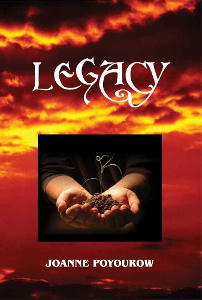


More about Legacy:
More about Legacy:


More about Legacy:


More about Legacy:
Global Warming, sea levels rising, glacial melting, rainforest and ecosystem destruction, wildlife species extinction... it’s staggering to think about. Perhaps too overwhelming, for most of the mainstream population. Meanwhile the government and business community hang on to the status quo.
It’s a visualization gap.
What will life be like as climate change unfolds? What would life be like if private citizens, businesses and governments took positive action?
Legacy tells the tale.
Legacy is the story of a small group of determined citizens who set out to lead society to Sustainability. The book tells the tale of fictional men and women, coping with very real events.
Set against the backdrop of climate change as forecast by the Union of Concerned Scientists and the Intergovernmental Panel on Climate Change, and economic changes forecast by Robert R. Prechter, our group of heroes create solutions to the environmental and social issues facing them. The solutions they implement are based upon real innovations that exist in test cases today, as described in publications by Kenny Ausubel, Paul Hawken, Lester R. Brown, and a wide variety of others. Legacy is thus an illustration of the predictions of today’s experts in environmental science, economics, politics, and technology.
Legacy depicts issues and solutions from multiple arenas of life. Permaculture ethics, as described by David Holmgren, are an integral theme. Holmgren’s Permaculture Flower diagram shows the breadth of society that experiences change during the course of the story.
The protagonists carry out realistic lives: they fall in love, marry, make their livings, raise their children, and cope with the inevitable frustrations and disappointments, meanwhile facilitating 40 years of dramatic environmental and social changes.
Legacy is about values: reforming values that no longer fit in a changing world, and reconnecting with timeless values which our disposable I-want society has neglected. The book offers thorough illustrations of devoting one’s self to a cause, of commitment, of setting a vision for positive outcomes, and of supporting others in times of discouragement.
Despite the trials of climate change, challenging economic markets and
adverse politicians, the protagonists are successful in bringing the city
of Los Angeles to a more sustainable existence. In the process, Legacy
is a tale of hope, possibilities and a call to action.
Los Angeles is the largest metropolitan area in California. The state of California is the 5th largest economy in the world, and Southern California, embracing Los Angeles and San Diego, comprises the world’s largest economy. All is located within the country which is the heaviest consumer of world resources.
David Holmgren refers to "... the billion or so middle-class people across the planet who, more than the numerically few rich, consume the vast bulk of the planet’s resources." Legacy is written for - and written about - this middle-class. As a high-profile media center, Los Angeles could perhaps be called its capital.
If we can envision the possibility of sustainable change in mighty Los
Angeles, envisioning change for less daunting locations becomes all the
more possible.
What is the purpose of the book?
The purpose of Legacy is to translate the incredible complexity of the environmental and social problems facing us into something we can wrap our minds around: What will life be like, and how will it feel to be living through this period of massive change? How will our lives change? How will it feel to be one of those brave people who are making the changes happen?
The book illustrates the problems and their interrelated nature, while at the same time showcasing some of the myriad of real solutions that are already out there. While Legacy is far from a scientific document, its multitude of references (including portions of this website) point the reader to the heavy science. This book serves as an introduction and a tangible painting. Legacy brings the scary big picture down to something everyday people can begin to identify with and start to solve.
Additionally, Legacy creates an atmosphere of hope and possibilities. The protagonists succeed in their mission. They emerge as heroes. Environmental change is possible. We all need reinforcement in this belief, in order to keep on going. Legacy invites us to look at the hero in each of us, and shows how possible it is to give those heroics a voice.
Lastly, Legacy encourages people to join the Sustainability movement.
It raises consciousness of the impact of our choices. The book motivates
people to act and to change their habits. It causes each of us to take a
look at what legacy our individual choices and actions are leaving for future
generations.
What is the need for this book?
Particularly in these political times, the Sustainability movement needs
a few good heroes, and a tale of possibilities.
For those just getting started on the path of learning about and working toward social and environmental change, Legacy introduces some of the innovations that already exist. The book showcases a wide variety of theories, inventions, events, and concepts under development, in fields as diverse as international negotiations and religion, biodynamic agriculture and alternative housing. Legacy is a novel with nonfiction footnotes, cultivating an awareness of the reality of our environmental scene.
For those who have long been on the path of working toward societal change,
Legacy offers encouragement and a lift for the spirit. It can get
quite discouraging to be working in this arena, when the political environment
is so adverse, yet change is so urgent. We cannot give up. Legacy
reminds us to believe.
Nonfiction environmental materials depicting hope and possibilities are in slim supply. The works of Kenny Ausubel, Alan AtKisson, and Paul Hawken stand out as positive beacons.
Legacy is different in that it is uses fictional characters to show how climate change and other environmental and social issues will affect everyday people. How will we live our lives, raise our families, make our livings, in the midst of all these changes? Legacy tells the tale.
In Legacy, as in Ausubel’s books, the bad news is the setting; the main focus is on the technology and social change ideas that bold thinkers and activists are bringing to life.
As a novel, Legacy has the advantage of readability. For some readers, nonfiction technical materials are challenging. Legacy brings factual material about the sustainability movement into an accessible form.
Environmental novels depicting hope and possibilities are next-to-nonexistent. Most environmental stories available are gloom-and-doom disaster stories, sensationalist thrillers, or something offering space aliens and exotic droids as the salvation of mankind.
Legacy is different in that the technology, theories, approaches that are portrayed are REAL. They exist in some form somewhere around the world. Some may exist only overseas, some may exist piecemeal, some may currently be experimental, or in the planning stages. But what if they became part of mainstream society? Legacy is a bold illustration of that giant What If.
Additionally, Legacy is a story of empowerment. The solutions don’t come from outside, they are orchestrated before your eyes by our group of heroes, in an effort that combines grass-roots triumphs with changes at the highest national and international levels. Our small group of thoughtful, committed citizens does change the world.
Legacy is a clear picture of the bounty that can be, if we all make changes toward a better world, thereby creating a richer legacy for future generations.
![]()
More about Legacy:
The Story * The Science * The Community
Preview Legacy at Google Books
photo credits: Landfill by R. Burgos S., San Jose, Costa Rica; Pumping Oil2 by Julie Elliott, Wichita Falls, TX; Industrial 3 by Kenn Kiser, Pataskala, OH; Drainage pipe by Terence O'Brien, Philadelphia, PA; Big Harvest 2 by Charles Thompson, Clinton, NY; Dead bird by Ivo Ruijters, Hilversum, Noord Holland, Netherlands; Freeway overpass by James Lin, Simi Valley, CA; Power Sunset by Joseph Ziomek, Pottstown, PA; Kids' Playground 5 by Ivan Philipov, Plovdiv, PB, Bulgaria; Best Friends Forever by Patti Gray, Kewanee, IL; Sisters and Friends by Melissa Gutierrez, Geneva, Switzerland; children by Jean Tracewell Photography, Santa Ana, CA; Child close up 2 by Gina Meyers, Los Angeles, CA; Friendship by R. Burgos S., San Jose, Costa Rica.